In Montenegro, you’ll often hear the phrase “Ostroga mi,” which means “I swear by Ostrog.” Montenegrins use it to make serious promises, swearing not by God or family, but by this monastery. That says a lot about how important this place is.
Ostrog Monastery is carved into a cliff 900 meters above the Bjelopavlići Plain in central Montenegro. It stands as one of the most visited religious sites in the Balkans a rare convergence of architecture, nature, history, and an intangible presence that resonates with visitors, believer or not.
Built into the impossible
The first time you see Ostrog from afar, it makes you do a double-take. The Upper Monastery seems to hang on the cliff, its white walls pressed against the grey rock like someone built a house inside the mountain and then took away the front wall to show it. It really looks like it shouldn’t be there.
The monastery was founded in the 1660s by Bishop Vasilije Jovanović, later Saint Basil of Ostrog, as a refuge from the advancing Ottoman Empire. He selected three caves high in Ostroška Greda, building the Church of the Presentation of the Holy Virgin in the first, a pilgrim guesthouse in the second, and reserving the third for sacred relics.
The monastery was built by hand over many years, high up on tough terrain. Its survival through earthquakes, fires, wars, and harsh weather is hard to explain by engineering alone, and it impresses even those who don’t believe.
Two monasteries, one experience
Many first-time visitors don’t realize that Ostrog is actually two separate complexes. The Lower Monastery, built in the 19th century, lies about two kilometers below the Upper Monastery and is where most people start their visit. It’s quieter and less crowded but often overlooked in the rush to get to the top. That’s a shame because the Church of the Holy Trinity has beautiful frescoes worth a closer look. Behind the church, there’s a natural spring where you can fill your water bottle. The water is cold, clean, and locals believe it’s blessed.
From the Lower Monastery, a paved road winds steeply up to the Upper Monastery. You can drive it in about 10 minutes or walk it in around 30. If you’re able, walking is the better choice. The shaded path through the woods is peaceful and lets you soak in the atmosphere before you reach the top. Many pilgrims climb barefoot, a tradition going back centuries. You don’t have to do the same, but watching them gives you a new perspective.
The Upper Monastery holds the heart of Ostrog – the cave churches, Saint Basil’s relics, and stunning views. The relics are kept in a very small chapel. During busy times, the line to get in can be long, and inside, only a few people fit at once. It’s an intimate and sometimes overwhelming experience, especially knowing you’re standing in a decorated cave built into a steep cliff.
At the far end of the highest balcony, across from the church, a grapevine grows right out of bare rock. It shouldn’t be there nothing should grow from solid stone but it does. Locals call it the Miracle Vine, and even the most skeptical visitors often stop to look at it a little longer than they planned.
Stories that cling to the walls
Saint Basil died in the monastery in 1671, at the age of 61. Seven years later, according to tradition, the abbot of a nearby monastery began having recurring dreams in which Saint Basil appeared and asked him to open the abbot’s tomb. When the monks did so, they found the body had not decomposed. From that moment on, Ostrog became a pilgrimage site, and the stories of miracles began to accumulate.
There are stories of healings, prayers answered, and people coming to Ostrog as a last hope and leaving with something new. Whether you believe these stories or see them as expressions of hope, they are part of what makes this place special. People of Orthodox, Catholic, and Muslim faith all visit Ostrog, which is unusual for a Serbian Orthodox monastery and shows how far its reputation reaches.
One story not about miracles but about the monastery’s resilience comes from World War II. In 1942, occupying forces dropped a bomb right on the Upper Monastery. It broke in half after crashing through the building but didn’t explode. The shell casings are still kept inside the monastery today you can see them if you look closely. It’s the kind of detail that makes you rethink what you know about chance and luck.
The drive from the coast
Getting to Ostrog from Budva or Kotor means driving about 120 to 130 kilometers, which takes two to two and a half hours. The easiest route is to drive to Podgorica, then take the newer highway toward Danilovgrad and Nikšić, following signs to the monastery. This road is well-maintained and fairly quick, with beautiful scenery that changes from the Mediterranean coast to the Zeta Valley, where wide plains stretch between mountains.
An older road off the Podgorica – Nikšić highway is steep and narrow some GPS routes use it, but it’s less comfortable than the longer, newer Danilovgrad road. For an easier drive, especially if you’re not used to mountain roads, the new road is recommended.
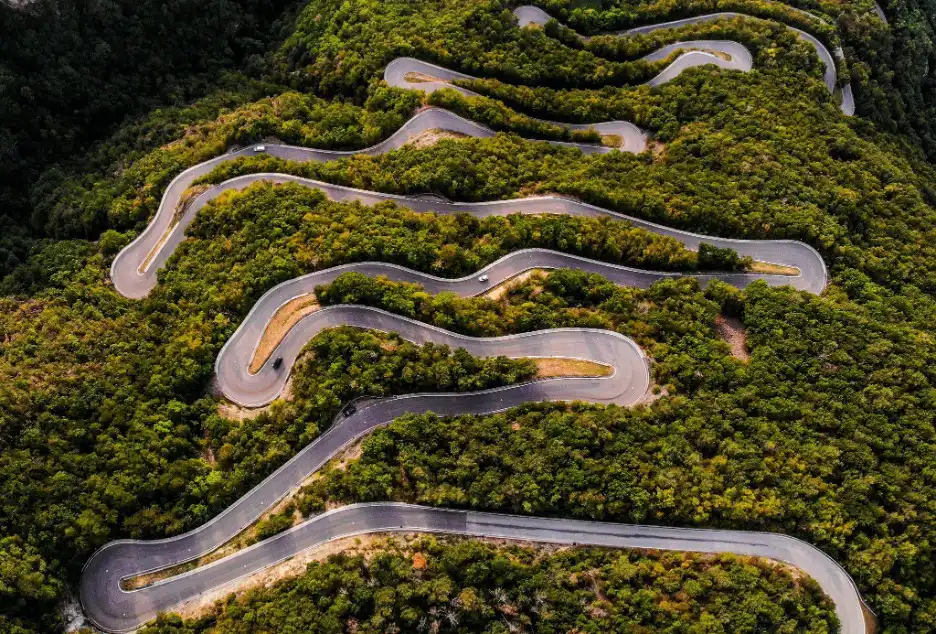
One thing to keep in mind is the final stretch the road from the mountain base up to the Upper Monastery has tight switchbacks climbing steeply. It’s paved and doable but requires your full attention, especially when other vehicles come the other way. In summer, parking near the top can fill up quickly, so it’s best to arrive early.
Having your own vehicle makes visiting easier. There’s no direct bus, and the train to Ostrog station leaves a steep 90-minute hike before your visit. With a car, you can travel at your own pace, stop as you wish, and combine Ostrog with other sites in central Montenegro.
What to know before you go
A few practical tips to make your visit smoother.
Ostrog Monastery is open all year and free to enter. Dress modestly long pants and covered shoulders are expected. Even in hot coastal summers, bring suitable clothes because the mountain is only a bit cooler.
May is the busiest month due to the Feast of Saint Basil on May 12th. Summer weekends get crowded too. To avoid the crowds, try visiting on a weekday morning in late September, early October, or April.
Outside the entrance to Saint Basil’s cave church, there’s a basket where visitors can leave donations of clothes, food, or blankets for the monks and the poor they help. Cash donations are also welcome but should go in the donation boxes, not the basket. These small acts are part of the place’s culture, and even if you’re just visiting as a tourist, they offer a way to join a tradition that’s lasted for centuries.
Food options near the monastery are limited to a few small cafes near the Lower Monastery, so don’t expect a full meal, especially later in the day. If you’re driving back toward the coast and have time, Nikšić, Montenegro’s second-largest city, is about 25 kilometers away and offers many more restaurants and cafes.
More than what you expect
It’s easy to think of Ostrog as just another religious site, and it is definitely one of the country’s most important spiritual places. But what makes it worth the trip, even for those without religious ties, is something else the sheer wonder of the place, how it clings to the cliff like it’s defying gravity, the quiet inside the cave churches, and the view from the top balcony that stretches across the valley, making everything else feel distant and small.
Montenegro has beautiful beaches, stunning bays, and charming old towns. But Ostrog is different. It’s the kind of place that stays with you long after you leave the kind that pops into your mind on a random Tuesday months later, making you wonder: how did they build that? And why do I feel like I need to go back?
You would not be the first to feel that way. And if the centuries of visitors before you are anything to go by, you certainly will not be the last.