Most people who plan a trip to the Montenegrin coast spend their time bouncing between Kotor, Budva, and Sveti Stefan. Bar barely makes the shortlist. That is exactly what makes it worth a day, or maybe more.
This is a working port town with an Italian ferry, the country’s main commercial harbor, a 2,200 year old olive tree, the ruins of a medieval city up the hill, and a beach promenade that locals use every evening of the year. It does not put on a show for tourists, and the difference is felt the moment you walk through the marina or sit down for coffee in the old quarter. Prices run roughly 30 percent below what you would pay in Budva. The crowds are mostly Montenegrin and Serbian. The food is honest. The history is unforced.
If you are staying in Budva, Bar sits about 35 kilometers down the coast, which makes it one of the easiest and most rewarding day trips you can do. Here is the full picture.
Where Bar Sits on the Map?
Bar is the third largest municipality in Montenegro and the country’s main seaport. It is south of Budva and Petrovac, north of Ulcinj, and right at the foot of Mount Rumija, which separates the coast from Skadar Lake. From the waterfront you can see the harbor cranes, the marina, and the long pebble beach of Topolica all in one glance.
The thing that confuses most visitors is that there are essentially three different Bars, and they are not the same place.
Novi Bar is the modern town along the coast with the marina, the promenade, the King Nikola palace, and most of the hotels. This is where you arrive.
Stari Bar is the medieval fortress town 4 kilometers inland, at the foot of Rumija. This is what you actually came to see.
Bar Riviera refers to the coastal strip from Sutomore in the north down through Šušanj, Čanj, and the smaller bays toward Ulcinj. This is where the best beaches are.
Once you have these three sorted out, planning a visit becomes straightforward.
How to Get from Budva to Bar?
The drive from Budva to Bar is short, scenic, and generally easy outside of peak summer. Three routes are worth knowing about.
| Route | Distance | Off-season | Peak summer | Notes |
| Coastal road E80 | 38 km | 50 min | 1h 15min | Pretty drive through Petrovac and Buljarica |
| Via Sozina tunnel and Virpazar | 75 km | 1h 30min | 1h 45min | Detour through wine country, scenic alternative |
| Bus from Budva | 38 km | 1h | 1h 20min | 4 daily departures, around €5 |
The standard option is the coastal road, the Adriatic Highway. You leave Budva, climb a bit through Sveti Stefan and Petrovac, then drop into Sutomore and roll into Bar. In July and August, the stretch between Sveti Stefan and Petrovac jams up around midday, so an early start saves you time. For context on driving conditions across the country, our guide to whether driving in Montenegro is safe goes through this in detail.
The detour route is for people who have a full day and want to see more than just Bar. You drive inland from Budva to Cetinje, drop down to Virpazar on Skadar Lake, then take the Sozina tunnel (€2.50 toll) south to Bar. It adds about 45 minutes and lets you taste Vranac wine in Crmnica along the way. More on that later.
If you do not have a car, the bus station in Budva runs four direct services a day to Bar. The ride is about an hour and tickets cost around €5. You can do Bar as a day trip without driving, but you will be limited to the city center and the immediate area, because the buses between Stari Bar and the main town are infrequent and unpredictable.
Stari Bar: the Real Reason to Come
This is the part that locals quietly insist you do not skip. Stari Bar is a medieval fortress town that sat on the slopes of Mount Rumija for the better part of a thousand years, passed between Byzantines, Serbs, Venetians, and Ottomans, and was finally abandoned after the 1979 earthquake destroyed its aqueduct and made the site unlivable. What you see today is a partially restored open air archaeological park with around 240 stone structures spread across the hillside.
The walk in is through Starobarska Čaršija, a cobbled street lined with restaurants, small shops, and family-run konobas. You pass under the city walls through a stone gate where the relief of the Venetian Lion still watches over the entrance. Inside, the place opens up. The Ottoman aqueduct with its 17 stone arches sits at the foot of the hill, originally built in the 17th century to carry water from a spring three kilometers away. Inside the walls you find the foundations of the Cathedral of St. George from the 11th century, the remains of a Franciscan monastery later converted to a mosque, a Turkish hammam, and the Clock Tower built in 1753.
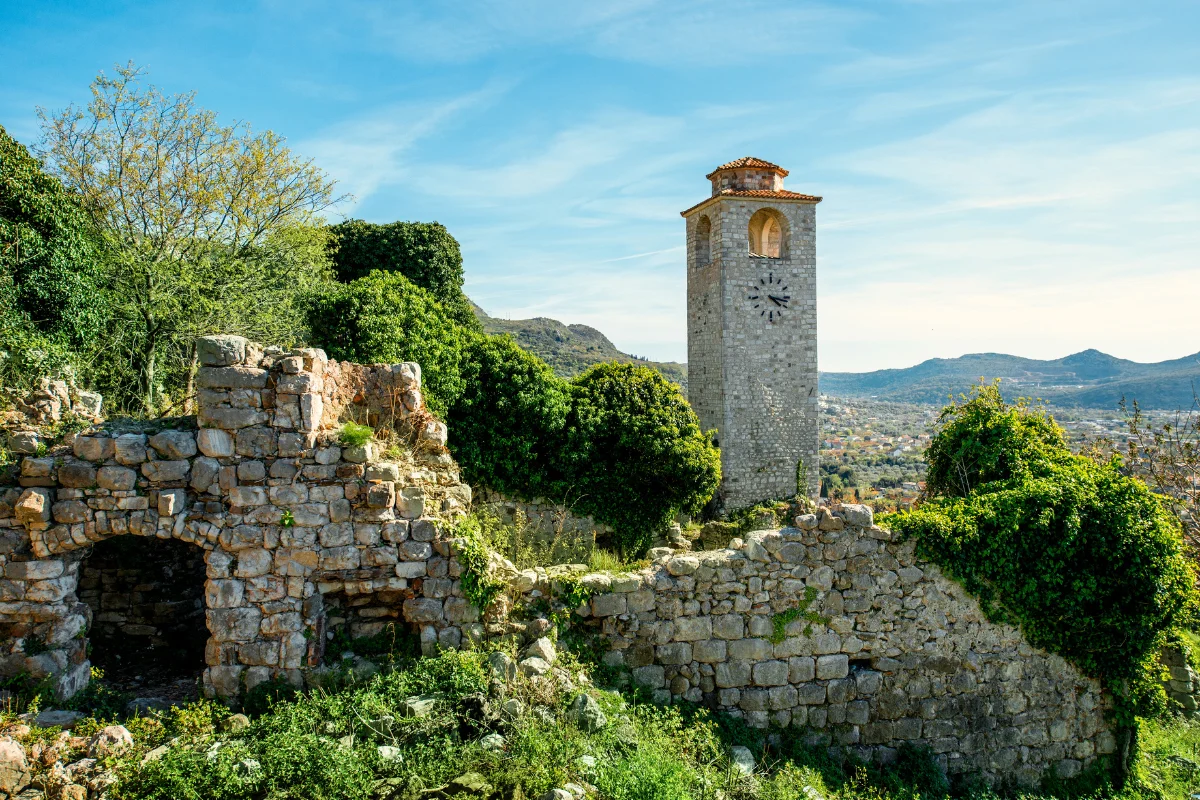
The Omerbašića Mosque sits just before the main entrance, completed in 1662. Legend has it that the merchant Omer Baša promised to build a mosque on whatever spot he was standing when the call to prayer caught him, and this is where it happened.
Practical details for visiting:
- Entrance: €5 adults, €1 children. Cash works best.
- Open: roughly 8:00 to 20:00 in summer, 9:00 to 17:00 in winter.
- Plan: 1.5 to 2 hours for a proper visit.
- Wear: real shoes, not sandals. The cobbles are slippery even when dry.
- Parking: a small lot near the entrance, paid (around €1 per hour), or free parking on the road just below the basketball court.
A note on parking touts. The lot right by the entrance occasionally gets worked by guys who collect a “parking fee” that does not exist. If you are unsure, ask at one of the cafés before paying. Locals will tell you.
The Old Olive Tree
Four kilometers from the center of Bar, in the village of Mirovica, sits one of the oldest living trees in Europe. A 2015 study estimated the inner trunk of the Stara Maslina at around 2,240 years old, which makes it older than most things in this part of the world by a comfortable margin. It is the third oldest olive tree on record globally and the oldest in Europe that still produces fruit.
You pay €1 to enter the small park around it. The visit takes 15 to 20 minutes, including time to read the small information board and walk around the trunk. There is a souvenir stall with olive wood pieces nearby. It is not a long stop, but combined with Stari Bar (less than a kilometer away) it fits naturally into the same morning.
Bar produces some of the best olive oil in the country, and the wider region around Mirovica still has thousands of trees over a thousand years old. If you happen to visit in early November, the Maslinijada festival (Olive Tree Festival) takes over Stari Bar with tastings, music, and local food.
The Waterfront, the Palace, and the Marina
Back down in the new town, the action is along the seafront. Topolica beach runs in front of the city, with the promenade stretching for about four kilometers north toward Šušanj. This is where locals walk every evening, which tells you most of what you need to know about whether it is worth doing.
King Nikola’s Palace sits right on the waterfront, a peach colored summer residence built in 1885 for the last monarch of Montenegro. The building normally houses the local history museum with royal furniture, period artifacts, and pieces from the Bar archaeological digs. Here is the important detail: the palace has been closed for major renovations since 2023, so check the current status before you plan around it. Even with the museum closed, the gardens around the palace are still worth a walk for the palm trees and the views back toward the marina.
Bar Marina is one of the better spots in town for lunch. The restaurants along the waterfront serve grilled fish, octopus salad, and the kind of seafood platters that locals order without asking the price. Average bill for two with wine runs €25 to €40.
The Beaches Around Bar
Bar itself has a long city beach, but most of the best swimming spots are a short drive in either direction along the Bar Riviera. Here is what you need to know.
| Beach | Distance from center | Type | Notes |
| Topolica | 0 km | Pebble and sand | City beach, easy access, in front of palace |
| Šušanj | 2 km north | Pebble | Tree-shaded, popular with locals |
| Sutomore | 8 km north | Sand and golden pebble | Largest, most developed, busy in season |
| Čanj | 14 km north | Sand | 800 meters long, family beach, calm bay |
| Queen’s Beach | 15 km north | Fine sand | Boat access only, hidden cove near Čanj |
| Veliki Pijesak | 12 km south | Sand | Quieter, popular with day visitors |
The swimming season runs roughly from mid May to mid October. Water temperatures climb above 23°C from June through September. If you have only an afternoon, Šušanj is the closest decent beach and Sutomore has the most facilities. For something quieter, Čanj is worth the extra ten minutes of driving.
Haj-Nehaj Fortress (worth the side trip)
If you are already heading to Sutomore for the beach, save an hour for the climb up to Haj-Nehaj. It is a Venetian fortress from the 15th century perched 231 meters above the bay, built to watch the coast against Ottoman raids. The walk from Sutomore train station to the trailhead is about 650 meters, then another two kilometers up to the fortress itself. Entrance is free. Wear proper shoes, bring water, and go either early in the morning or late afternoon to avoid the worst of the sun. The view from the top stretches across the entire bay.
Bar as a Day Trip from Budva: a Suggested Plan
If you are doing this in a day, here is a realistic itinerary that lets you see the essentials without rushing.
9:00 – Leave Budva, drive south on the coastal road.
9:45 – Park at Mirovica and visit the Old Olive Tree. Fifteen minutes is enough.
10:15 – Drive the short distance to Stari Bar. Park and walk up Starobarska Čaršija.
10:30 to 12:30 – Explore the fortress. Wander the ruins, climb to the upper terraces for the view back over the Bar valley.
12:30 – Lunch in one of the konobas along the cobbled street outside the fortress. Order grilled fish, lamb, or whatever the daily special is. Wash it down with local Vranac.
14:00 – Drive down to the new town. Park near the marina. Walk the promenade past King Nikola’s Palace and into the harbor area.
15:30 – Drive 10 minutes north to Sutomore or Čanj. Swim, eat ice cream, lie on the pebbles for a couple of hours.
18:00 – Head back to Budva. You will be sitting on a terrace by 19:00.
For wine lovers, swap the beach hours for a detour back through the Sozina tunnel to Virpazar and one of the small family wineries in Crmnica (Kopitović in Donji Brčeli is a good bet). It adds 90 minutes to the day but takes you through the heart of Montenegro’s main wine region. Our full guide to visiting Lake Skadar by car covers that route in detail.
When Bar Makes Sense as a Base
A day trip is enough for most people. But if you are spending a week or more in Montenegro and you want a calmer alternative to Budva or Kotor, Bar holds up as a base for two or three days.
Accommodation runs about 30 percent cheaper than the Budva Riviera. The restaurants away from the marina cater to locals rather than tourists, so a full meal for two with drinks lands around €15 to €25. You can do day trips from here to Skadar Lake (45 minutes), Ulcinj (25 minutes), and the Albanian border (an hour), all of which are harder to reach if you are based further north.
The Belgrade-Bar railway also terminates here. The route runs 477 kilometers across 254 tunnels and 435 bridges, including Europe’s highest railway bridge at Mala Rijeka, and is considered one of the most scenic train rides on the continent. It is a popular arrival route for travelers coming from Serbia who want to skip the long drive.
The Bar to Bari ferry runs during summer (roughly April through October), with crossings of about 8 hours starting from around €78 per passenger. If you are planning to combine Montenegro with a trip to Puglia, this is the easiest way across the Adriatic.
What Bar is not is a nightlife destination. If you want clubs, beach bars open until 4 AM, and the kind of summer party energy that defines Budva from June to August, you will not find it here. That is part of the reason to come.
Eating in Bar
Bar sits at the center of Montenegro’s olive growing region, and the local cuisine reflects it. Olive oil is everywhere and locals are particular about which producer they buy from. Seafood comes off the boats at the marina daily: grilled fish, octopus, squid risotto inked black, anchovies fried whole. In the konobas above Stari Bar, the kitchens lean toward the Ottoman side of the menu, with grilled lamb, lepinja bread, and small dishes of vegetables and cured meats.
The Crmnica wine region sits just inland behind Mount Rumija, and Vranac (the local red) shows up on most menus. It pairs naturally with grilled meat, prosciutto, and aged cheese. If you want a glass of white instead, ask for Krstač.
Mid-range expectations: €15 to €25 for two at a normal konoba, €25 to €40 at the marina restaurants. Cash is welcome everywhere. Cards work in most places but not all.
Practical Tips
Parking in the new town: The easiest is the paid lot near the marina, around €1 to €2 per hour. The promenade has metered street parking. For Stari Bar, the small lot at the entrance fills up quickly in season, so arrive before 11:00 or after 16:00 to avoid the crowd.
Currency: Euro, like the rest of Montenegro. ATMs are easy to find in the center.
Best time to visit: Mid-May through early October for swimming. Mid-September is the sweet spot, with warm water, smaller crowds, and the olive harvest just beginning.
Language: Montenegrin (essentially the same as Serbian and Croatian for travel purposes). English works in tourist-facing places. Italian is common too, given the ferry connection.
Driving from Budva: The drive is straightforward but the road through Petrovac narrows and slows in peak summer. Allow extra time. For longer routes around the country, our driving distances guide between Montenegrin cities gives realistic times for the main destinations.
Bar does not try to impress. That is exactly the point. After three days of Kotor’s cruise ship crowds and Budva’s beach club music, the slower pace and lived-in feel of Bar is a relief. The olive tree is real. The fortress is real. The locals who eat at the marina restaurants every Sunday are real. Spend a day here on the way south, or two if you can, and you will come back understanding a different side of Montenegro than the one that ends up on most postcards.