If you fly into Dubrovnik and drive south toward Montenegro, the first town that greets you after the border crossing is Herceg Novi. And most people drive right through it.
They’re in a hurry to reach Kotor, or Budva, or that one Instagram spot everyone keeps posting. Which is a shame, because Herceg Novi is the kind of place that quietly rewards those who stop and stay a while. No cruise ships clogging the harbour. No lines of tourists snaking through narrow streets. Just a sun-soaked town with more history per square metre than it probably knows what to do with, a waterfront promenade that stretches for six kilometres, and a laid-back energy that feels more local than performative.
Montenegrins themselves have known this for decades. Herceg Novi has been their go-to summer spot long before the rest of the world started discovering the country. And there’s a reason it keeps pulling them back.
A Town That Changed Hands More Than Your Car Keys
The history of Herceg Novi reads like a particularly dramatic game of musical chairs. The town was founded in 1382 by the Bosnian King Tvrtko I as a small fortress. It was originally called Sveti Stefan (yes, there’s another one), but the name didn’t stick. Instead, it became Herceg Novi after Duke Stjepan Vukčić Kosača, who turned it into an important trading hub for salt and silk.
After that, things got complicated. The Ottomans took over in 1482 and stayed for roughly two hundred years. During their reign, they built the Kanli Kula fortress, whose name translates to “Bloody Tower,” and the name is not a marketing gimmick. There was a brief Spanish interruption in 1538 when they held the town for about a year and managed to build the Španjola fortress before losing it again. Then came the Venetians, who stayed until 1797. After them, the Russians showed up for a year. Then the French under Napoleon. Then the Austro-Hungarians. Then the Italians during both World Wars. Then Yugoslavia. And finally, Montenegro as an independent nation from 2006.
The result of all this historical shuffling is a town where Ottoman towers sit next to Venetian walls, where a Spanish fortress overlooks Orthodox churches, and where the whole thing somehow works. It shouldn’t, architecturally speaking, but it does. Walking through Herceg Novi’s Old Town feels like flipping through the chapters of a very thick European history textbook, except the textbook smells like sea salt and coffee.
One curious piece of trivia that rarely makes it into travel guides: in April 1970, Herceg Novi hosted a blitz chess tournament featuring four World Chess Champions. It was considered one of the strongest blitz fields in modern chess history. So yes, this town has attracted kings, empires, and grandmasters.
The Old Town: Stairs, Cats, and Hidden Corners
Herceg Novi is often called the “City of Stairs” and you will understand why within five minutes of arriving. The locals call them “skaline,” and they are everywhere, connecting the waterfront to the hilltop fortresses in a steep, winding maze of stone steps. If you’ve skipped leg day for the past several months, Herceg Novi will remind you.
But the stairs are also part of the charm. Between them, you’ll find narrow alleys draped in bougainvillea, old stone houses with laundry hanging from windows, cats lounging in the shade (always cats), and small squares that feel like they belong to another century.
The natural starting point is the Clock Tower, known as Sahat Kula, built in 1667 during Ottoman rule. It sits at the western gate of the Old Town and has become the unofficial symbol of the city. Walk through the archway beneath it and you’re on Herceg Stjepan Square, also called Belavista Square, which is the heart of everything. The Church of St. Archangel Michael stands in the centre. It took 22 years to build, was completed in 1905, and its architecture is a peculiar but beautiful blend of Byzantine domes, Romanesque arches, and Serbian Orthodox interiors.
From Belavista, the stairs lead up to Kanli Kula, the Ottoman fortress turned open-air theatre. In summer, it hosts concerts and film screenings, and the panoramic views of the Bay of Kotor from the top are worth every step. Further up is Španjola, the Spanish fortress, which is less restored but perhaps more atmospheric because of it. You get the ruins, the silence, and the same sweeping views, minus the crowds.
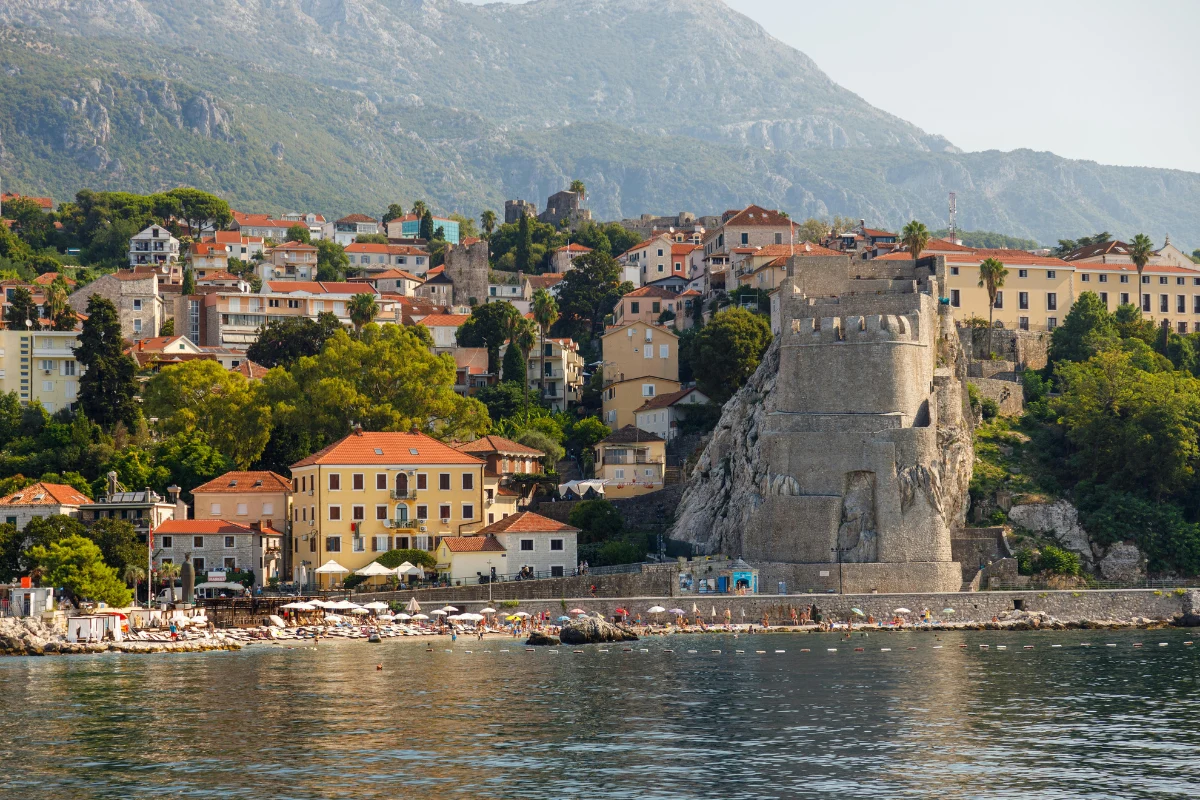
Down at the waterfront, Forte Mare guards the sea entrance to the town. Built between the 14th and 17th centuries, it’s arguably the most photographed spot in Herceg Novi, especially at sunset, when the light catches the old stone walls and the bay turns gold behind it.
The Promenade: Six Kilometres of Doing Nothing in the Best Way
The Šetalište Pet Danica is a six-kilometre waterfront walkway connecting Herceg Novi to the neighbouring town of Igalo. It’s lined with palm trees, cafés, small beaches, and locals walking at a pace that suggests nobody here is in any particular rush to get anywhere.
This is where Herceg Novi really shows its personality. Families strolling in the evening. Old men playing cards at café tables. Kids running along the water. The occasional busker. There’s no agenda here, no must-see attraction. You just walk, stop for a coffee, walk some more, maybe sit on a bench and stare at the bay for twenty minutes. It sounds like nothing, and it sort of is, but it’s the kind of nothing that leaves you feeling like you’ve actually been on holiday.
Along the way, you’ll pass several swimming spots. The beaches in Herceg Novi itself are modest, mostly concrete platforms and small pebble coves. But the real gems are a short boat ride away. Žanjice and Mirište are two gorgeous white-pebble beaches on the Luštica Peninsula, reachable by speedboat from the harbour. While you’re out there, the Blue Cave is worth a stop as well, a natural sea grotto where the water glows an unreal shade of blue when the sun hits it right.
Igalo: Healing Mud, Tito’s Villa, and Scandinavian Pensioners
Walk far enough along the promenade and you’ll reach Igalo, which has a story all its own. Back in the 1930s, the French Vichy Laboratories tested the mineral-rich sea mud extracted from the shallow waters of the bay here and confirmed its therapeutic properties. After World War II, the Institute Dr. Simo Milošević was established, and Igalo gradually became the biggest medical spa on the Adriatic coast.
For decades, this was the wellness destination of the Balkans. Patients and tourists came from across Yugoslavia and beyond for mud treatments, mineral water therapy, and rehabilitation programmes. Visitors from Scandinavian countries, particularly Norway, have been loyal regulars for years. The institute is still operating today, offering everything from rheumatology rehabilitation to simple wellness retreats. If you want a unique experience, you can go to Blatna plaža (Mud Beach), apply the famous healing mud directly from the shore, and have yourself a spa treatment for free.
And then there’s Villa Galeb. This was Josip Broz Tito’s summer residence, where the former Yugoslav leader received foreign dignitaries, got medical treatments, and generally enjoyed being Tito. The villa has been turned into a museum, with the original furniture and décor left untouched since his death in 1980. It’s a fascinating, slightly eerie time capsule of mid-century Yugoslav grandeur.
What to Eat (and Drink)
Herceg Novi’s food scene leans heavily on the sea, and that’s exactly how it should be. Fresh fish, grilled and served whole with a drizzle of olive oil and a side of blitva, is the default order at most waterfront restaurants. Octopus salad is practically a local institution. Mussels from the bay are excellent. And if you’re willing to venture beyond seafood, Njeguški pršut (dry-cured smoked ham from the village of Njeguši in the mountains above Kotor) paired with local cheese makes for a perfect appetiser.
For wine, two names to remember: Vranac for red, Krstač for white. Both are indigenous Montenegrin grape varieties, and both are worth trying. But for something more special, drive a few minutes outside town to Castel Savina, a boutique winery overlooking the bay. They grow several varieties including Žižak, an indigenous white grape, and tastings come with guided tours, local nibbles, and genuinely beautiful views. You’ll need to book in advance.
Don’t skip the Savina Monastery on the way. This Serbian Orthodox monastery complex sits in a dense Mediterranean forest just outside the Old Town and comprises three churches, the oldest dating back to the 11th century. It’s calm, shaded, and beautiful, and if you’re lucky, you might catch the monks tending their garden.
The Perfect Base for Exploring the Bay
One of the best arguments for spending a few nights in Herceg Novi is its location. Sitting at the very entrance to the Bay of Kotor, it gives you easy access to some of Montenegro’s greatest hits without being in the thick of the tourist chaos.
Kotor is about an hour’s drive along the bay, and if you’ve rented a car, the coastal road itself is half the experience. Perast is even closer and might just be the most photogenic small town in the country. From there, you can take a boat to the island church of Our Lady of the Rocks. Budva is further south if you want nightlife and busier beaches.
The most popular option from Herceg Novi, though, is a day-long boat tour through the Bay of Kotor. These depart from the harbour and typically include stops at Our Lady of the Rocks, Kotor, and Perast. It’s a great way to see the bay without dealing with traffic and parking.
Going the other direction, Dubrovnik is only about 90 minutes by car, making it an easy day trip if you want to cross the border into Croatia.
And if you’re the type who prefers mountains over coastline, the Lovćen National Park and the Njegoš Mausoleum are a few hours’ drive, or you can push further north to Durmitor for serious hiking. Having your own wheels opens up all of these options, and Herceg Novi’s quieter, more affordable atmosphere makes it a smart base to return to each evening.
Practical Things Worth Knowing
Getting there: The closest airport is Tivat, about an hour away. Dubrovnik Airport in Croatia is roughly 90 minutes. Podgorica Airport is about two hours. If you’re coming from Dubrovnik by road, the border crossing at Debeli Brijeg is the main one. It can get slow in peak summer, so plan accordingly. The smaller crossing at Kobila/Vitaljina is sometimes quicker.
Getting around: Within Herceg Novi, you walk. That’s it. The town is compact but steep, so comfortable shoes are essential. For day trips, a car makes the biggest difference. Public buses run along the coast, but they don’t reach the hidden beaches, viewpoints, and mountain roads that make exploring Montenegro so special.
When to visit: Summer (July and August) is peak season, with the warmest weather and the liveliest atmosphere. But Herceg Novi is pleasant from May through October. September is arguably the sweet spot, with warm sea temperatures, fewer people, and lower prices. If you visit in late January or early February, you might catch the Mimosa Festival, a celebration of the yellow flowers that bloom all over the town. In August, the Montenegro Film Festival takes over.
Accessibility note: Herceg Novi is not an easy town for anyone with limited mobility. The stairs are everywhere, and many of the Old Town’s streets are steep and uneven. The waterfront promenade is flat and accessible, but the upper parts of town present real challenges.
Accommodation: You’ll find everything from budget apartments to four-star hotels along the waterfront and in the hills above. Herceg Novi is generally more affordable than Kotor, Tivat, or Budva, and the quality of rental apartments is surprisingly good.
So, Who Is Herceg Novi For?
If you’re looking for a party scene, cruise-ship energy, or a destination that revolves entirely around tourism, you’ll probably be happier elsewhere on the Montenegrin coast. Herceg Novi isn’t trying to be Budva and it isn’t trying to be Dubrovnik.
But if what you want is a place with genuine local rhythm, where the cafés are full of Montenegrins rather than tour groups, where history is literally built into the walls around you, and where the pace of life encourages you to slow down and actually enjoy your holiday, then Herceg Novi is hard to beat. It’s the kind of town that doesn’t shout for attention. It just sits there, sun-drenched and unbothered, waiting for the right kind of traveller to notice.